
'Xi's emphasis on enhancing conventional military deterrence capabilities, joint operations and power projection are likely to increase friction points with India as with other nations,' points out China expert Srikanth Kondapalli.

Prime Minister Narendra Modi had gone to China with a bagful of initiatives, but not all seems to have been fulfilled given China's reluctance to go the whole hog with him

New Delhi and Beijing are the only two regional capitals that have commented on US President Donald Trump's speech on August 21 outlining the way forward in Afghanistan. The Indian foreign ministry statement was effusive in praise, while the Chinese statement has been one of cautious and guarded hope. Delhi has identified itself with Trump's Afghan strategy, whereas the Chinese stance is calibrated -- observant and objective, keeping a distance, says Ambassador M K Bhadrakumar.

China on Tuesday joined a war of words with the United States over letting whistleblower and former Central Intelligence Agency contractor Edward Snowden to leave Hong Kong saying that it is "unreasonable" for Washington to criticise the decision and make "groundless" accusations.
US Assistant Secretary of State for South and Central Asia Nisha Desai Biswal believes the India-US nuclear deal is not in limbo and it is for India and Pakistan to set the pace for conversations to resolve their issues. Rediff.com's Aziz Haniffa reports from Washington, DC.

The ecosystems of India and China today jostle against one another across Asia and much of the world.
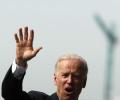
United States Vice President Joe Biden on Monday left for a rare vice presidential trip to India for the first leg of his visit to the Asia-Pacific region.

India must also not rule out dialogue with Pakistan. However, talks with Pakistan must be structured, and further progress must be based on visible results.
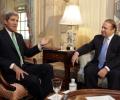
Pakistan Prime Minister Nawaz Sharif continues his exhortation for US mediation in Kashmir, and harks back to his meeting with former Prime Minister Atal Bihari Vajpayee when the latter had agreed to a resolution of Kashmir imbroglio; senior us officials assert there is 'absolutely no change in us policy' that Kashmir has to be resolved bilaterally. Aziz Haniffa reports.

'By the time he came out after nearly five hours, he had a one-to-one conversation with the President, a delegation-level meeting, a reception, a dinner, a tour of the White House and a joint statement of a kind none of his predecessors ever had,' says Ambassador T P Sreenivasan.

PM Modi seems to be gradually ending India's strategic ambiguity

'How can Kashmir be demilitarised if the terrorist threat remains and Pakistan continues to incite elements in Kashmir to keep the internal situation unstable?' asks former foreign secretary Kanwal Sibal.

Condemning terrorism in all its forms and manifestations, US President Barack Obama and Pakistan Prime Minister Nawaz Sharif on Thursday said that no country's territory should be used to destabilise its neighbours.

With Donald Trump the appeal has to be to his business instincts in which his personal interests seem to play a significant role, says former foreign secretary Kanwal Sibal.
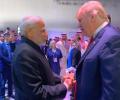
'India will come increasingly in the US crosshairs if it insists on maintaining its strategic autonomy, warns Ambassador M K Bhadrakumar.
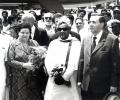
'I was present at a meeting where he decided to permit the IAF to strike at Pakistan positions in Kargil, with the caveat that they should not cross the LoC.' 'Confident that the Indian Army would succeed, Mr Vajpayee was positioning himself to tell the world after the Kargil conflict was won that India did not violate the 'sanctity' of the LoC,' recalls Ambassador G Parthasarathy, who served as India's envoy in Islamabad in that eventful year, 1999.
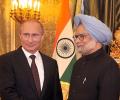
The 13-page joint statement issued after Prime Minister Manmohan Singh's annual summit with Russian President Vladimir Putin shows the breadth and depth of relations between the two countries and the trust factor that has been constant element behind it.

'Ensuring through diplomatic means and in conjunction with strategic partners that India will not be required to fight a simultaneous two-front war with China and Pakistan.' Brigadier Gurmeet Kanwal (retd) lists what India must have in its national security strategy.

New Delhi remains a priggish suitor to Washington's overtures, but it has begun appreciating potential tech benefits to ties with the US.

The outcome of the Bangkok NSA-level talks underscores that Pakistan has got exactly what it wanted -- talks at different levels, talks on Kashmir, talks on mutual concerns regarding terrorism, talks on ceasefire on the border. What if any has been India's gains remains unexplained, says Ambassador M K Bhadrakumar.

'We use the word "historic" perhaps too much, but the prime minister's visit certainly was historic in so many ways.'

'The entire Ufa fiasco was predictable and predicted. The Ufa venue had created international interest in the initiative and its failure may have implications for both Pakistan and India. What remains for Modi to do is to produce a prettier rabbit out of his hat next time to deal with the Pakistan imbroglio,' says Ambassador T P Sreenivasan.

Pak seeks US help to ease tensions with India.
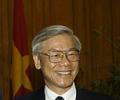
India-Vietnam relationship has its own imperatives and dynamism. In India's look east policy Vietnam has been the major pivot, at least in terms of security and strategic imperatives, says Rup Narayan Das.

'The US wants Modi to succeed because we want India to succeed. For our part, when India thinks of its partners in the world, we want it to think of the US first. That means positioning our country as the preferred provider of the key inputs that can help to propel India's rise.' 'The meeting between Modi and Obama is, and must be, an opportunity for true strategic dialogue -- not a scripted exchange of talking points, but an open discussion of the big questions. What kind of world do we want to live in? What are our true priorities? And most importantly, why does this partnership still matter?'

'It is in the interest of both sides that the visit of the US President is seen as being successful. Both sides have invested considerable political capital in it. This rapid exchange of visits and the decisions taken have to be justified, beyond the symbolism, which is no doubt important in itself. This opportunity to impart a fresh momentum to ties should not be missed,' says former foreign secretary Kanwal Sibal.

The new government needs to clearly insist on diplomatic reciprocal arrangements with China. While reciprocity is a function of power in bilateral relations, the Modi-led government's responses should be based on India'S inherent strengths, says China expert Srikanth Kondapalli.

'We should expect a cold-blooded, transactional relation that requires a lot of engagement and mutual trust to sustain,' says Constantino Xavier, Fellow, foreign policy, Brookings India.

PM Modi addressed the Sri Lanka Parliament on Friday.

Prime Minister Narendra Modi this month will be undertaking one of the longest ever abroad visits by an Indian head of government in recent times. He is scheduled to be on a nine-day, three-nation visit to Myanmar, Australia and Fiji from November 11 to 19. Later in the month, he will be in Nepal to attend the South Asian Association for Regional Cooperation summit on November 26-27.

'Both Modi and Xi know that if all that there is to show for Modi's visit -- barely eight months after Xi's India trip -- is a repeat of the same old declarations, there will be a terrible sense of letdown in the public mood resulting in future summits losing credibility. Only the possibility of new ground being broken can justify Modi's trip at this time,' says B S Raghavan.

When a Chinese warship entered Japanese waters, the Indian commander called on China to maintain discipline at sea. Dr Rajaram Panda explains the significance of the Malabar exercises between India, Japan and the US.

Admiral Samuel J Locklear III, Commander of the US Pacific Command, has not ruled out militants fighting in Afghanistan today switching their attention back to Kashmir post-US and NATO withdrawal of its troops from Afghanistan, and expressed concern over the recent terrorist attacks across the Line of Control that has exacerbated tensions between India and Pakistan.
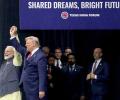
'The biggest takeaway is that the US-India relationship, which has sputtered a bit in recent months, enjoyed a big boost.'

'India-US defence pacts are seen by many analysts as a subtle move to jointly contain China's growing militarism, especially in the strategic Indian Ocean Region.'

Talking about the Line of Actual Control, Defence Minister Nirmala Sitharaman said as it is not completely demarcated, there are differing perceptions about it by both sides.
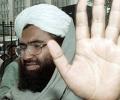
"My impression is that India can expect cooperation from China on the issue of declaring Masood Azhar, leader of JeM, as terrorist who should face trial in India, if India in the UN concentrated more on him than seeking to censure Pakistan as a sponsor of terror," Swamy said.

India has sought access to Lashkar-e-Tayiba operative David Headley, the Mumbai terror attack convict now lodged in a US prison, as it insisted on bringing to justice the perpetrators of the 26/11 assault.

India and China decided to seek a fair and rational solution to their border dispute on Saturday as they focused on the proposed border defence cooperation agreement to avert incursions like the one witnessed in Leh region last month.
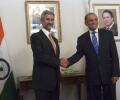
Pakistan's holy trinity -- its government, military establishment and the ISI -- differ on Pakistan's domestic and foreign policy issues. So when India talks to Pakistan's political leadership it can't be sure that the promises can be delivered, says Brigadier S K Chatterji (retd).
